The Left-Handed Blow
Art in the Age of AI Reproduction
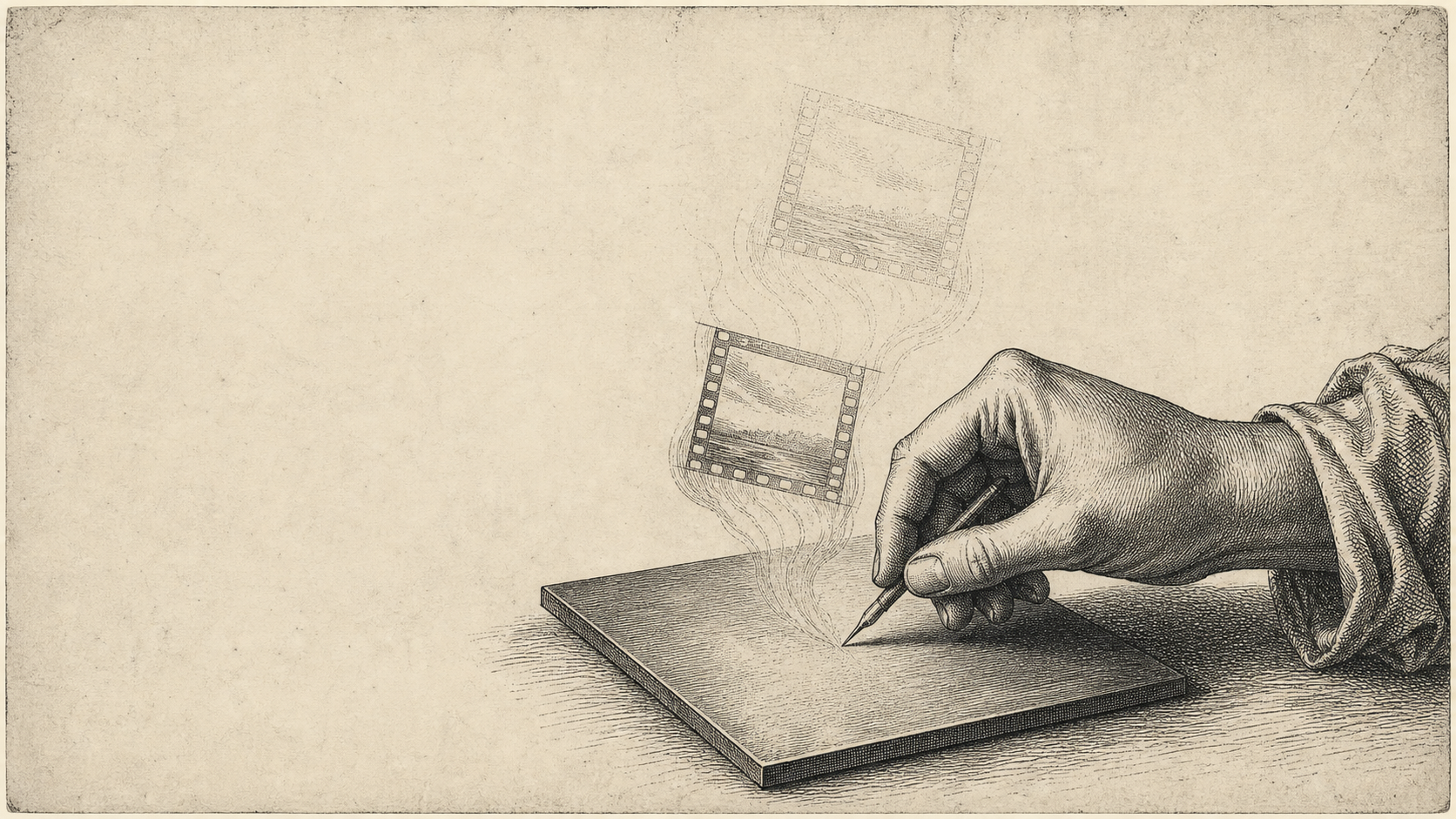
I first read Walter Benjamin's "The Work of Art in the Age of Mechanical Reproduction" during my freshman year, in an advanced film theory course at Clark University. Required reading. It was in Illuminations, the collection of his essays edited by Hannah Arendt. I was seventeen, always young for my grade, having basically skipped kindergarten, and was seeking the knowledge I thought I'd need to begin my life as a filmmaker. It was autumn, and I distinctly remember standing on a street corner in downtown Worcester, traffic passing, watching a man in a wool coat buy a newspaper from a machine. Benjamin's words about aura and reproduction circled in my head as the man disappeared into a donut shop.
Benjamin's argument, written in 1935, is that mechanical reproduction destroys the aura of the artwork. I don't remember how this was taught in class, but the way I'd put it now is: it's the special sauce, something essential, what you'd call the soul if we were talking about a person. That is not quite what Benjamin meant, but it's where I've taken it. Specifically, Benjamin was writing about photography. A painting exists once; a photograph of it can exist everywhere at the same time, and the copy cuts the work loose from what he called its "fabric of tradition." Then he turns. The same technology, he says, can make politics aesthetic. Fascism aestheticized politics; communism answered by politicizing art.
Benjamin was a Jewish intellectual watching the Nazis use film and radio to turn political life into spectacle. He wrote the essay in exile in Paris. At the same time, my maternal grandmother, Leah Hecht, was in Krakow. Four years later Hitler invaded Poland, and everything changed. Benjamin, fleeing the Gestapo, died at the Spanish border in 1940. My grandmother survived Auschwitz and lost her family, including a husband. So the essay is not abstract for me. It was written by someone who understood what happens when the machinery of image-making is captured, in the same years it was being captured around the people I come from.
This is why when the president reposts a video that is obviously AI-generated, him wrestling a tiger, him dropping ordnance from a fighter jet, Benjamin comes to mind every time. We now have a technology that makes as many images as anyone wants. We have political actors who understand exactly what that is for. And we have a film industry still arguing about whether an AI image counts as "real art." The truth is most people have no idea how fast this is moving.
So that's the backdrop.
Another memory. It's the early 1980s, and I'm watching 2001: A Space Odyssey for the first time, at a movie night in the synagogue where my father is the rabbi, in Brooklyn. The setup: two sixteen-millimeter projectors side by side in the back of the ballroom, folding chairs in rows, a screen above the stage. The room smells of floor wax and popcorn. When the monolith appears on screen, I grip the chair's edges until my fingers hurt. Entranced, terrified, awestruck. Is this the aura in action?
Within Benjamin’s framework, film already had an aura problem. It was always a mechanically reproduced art form, which is part of why critics for decades argued about whether it even was art. But, over time, filmmakers built an aura around authorship: Think Welles, Kubrick, Cassavetes, Bergman, Kurosawa, Scorsese. The director became the singular hand behind the multiplied object. AI threatens that compensation. When a model trained on the collective output of cinema can generate a "Kubrickian" shot in seconds, the question isn't just "where did the image come from" - it's "where did the intention come from." As Benjamin showed with photography and painting, the aura was always partly a fiction about the artist. AI makes that fiction harder to maintain.
So we go back to the essay. Benjamin distinguished between the cult value of art - its almost sacred, ritual function, the way you possess it and it has power - and its exhibition value, its availability and democratic spread. AI-generated imagery has essentially zero cult value in Benjamin's terms. It has no unique origin, no hand, no moment of making. This is precisely why so many artists react viscerally to it. It feels like a category violation.
Meanwhile, the practical landscape has caught up to the philosophical one. Social media is now flooded with fake AI-generated influencers and movie trailers, with creators racking up likes and views by exploiting studio IP and actor likenesses. The studios' response has been revealing: rather than issuing takedowns, they're quietly claiming monetization on these videos, profiting from content that uses AI-generated versions of their own talent without consent. The talent unions, understandably, call it a race to the bottom. And yet enforcement remains inconsistent at best, because the studios themselves can't decide whether these fake trailers are free marketing or intellectual property theft. Hollywood is in a don't ask, don't tell moment.
I sit at my desk. I should be preparing my taxes, tallying up how much I made this year, how much we spent. Outside, a neighbor is shoveling in front of his house, the scrape of his shovel against the concrete. In the basement, in the boiler room, I know a pipe is leaking, driving up my water bill. The plumber wants a lot of money to fix it, and this kind of repair - steam piping - is enough outside my circle of competence that I know I must relent. And I think, this confusion - institutional, philosophical, economic - about what things are worth, what labor costs, what knowledge matters - it fills the space around us like oxygen. We have no choice but to breathe it. The question is what happens inside our bodies once we do.
But the aura problem and the fake trailer problem are both, in a sense, abstractions - philosophical puzzles that are removed from the daily reality of making a living in this business. The part that doesn't feel abstract at all is the labor picture.
The film industry is contracting. Netflix just cut a thousand jobs. Fewer productions get greenlit, budgets shrink, post schedules compress, and the people who do the physical work of making film and television are watching their income go one direction. I know where it's going. Producers ask me, and a sound recordist is how most know me, whether I've heard of anything happening. It's what everyone talks about between setups or at lunch on any shoot. That is, if the shoot isn't a corporate communications webcast or a live event for an AV company, which is where my money is starting to more reliably come from. People who were working full-time three years ago now describe themselves as "semi-retired."
Let me sharpen the focus here. This year I launched a podcast called Films Not Made, co-hosted with Amy Hobby, an Academy Award-nominated producer. We invite filmmakers to tell us about a project they never got to make, one that fell apart in development, lost financing, got shelved, and then, using generative AI, we build speculative material of what the film might have looked like. Imagined casting, a new pitch deck, mock trailers. The filmmaker watches it happen and reacts in real time. Then they pitch the film to an AI avatar posing as a studio executive. It's fun, strange, and usually a reminder of how bad AI is at "taste." For now, at least. Think of it as a development session crossed with a séance.
Amy is the kind of person who, in any rational version of this industry, should have a clear path to making a living. "People expect you to work for free," she says. Producing at her level means years of development with no money until a project gets financed, which increasingly it doesn't. Then she tells me everyone is looking for work; fired executives from the streamers are sending her their resumes. This has always been a hard business with long odds. It's worse now.
Isn't this an AI problem? Not completely. The contraction started before the tools: the peak-TV bubble popped, the money got cautious, and the industry has been shedding its middle for years. Then the pandemic. Production stopped, expenses were cut, and stock prices climbed. Who wouldn't want to continue that trend? But AI is accelerating it. When a studio can rough out a trailer without hiring an editor, you are watching the org chart get built live. Just as in other parts of the economy, the ideal business size is looking more and more like one person and an infinite number of AI agents.
These same tools have also expanded what this show could be. Films Not Made has editors, a producer, a production pipeline; we're not replacing anyone. But the speculative visuals, the imagined casting, the synthetic frames of films that were never shot: no realistic budget would have covered that work the traditional way. It wouldn't have existed. The AI didn't replace a crew. It created something that was never going to be crewed in the first place. We would never have cast and shot a trailer for Michael Tully's unmade film about the rap beef between Kool Moe Dee and LL Cool J, a 1980s period piece with headline actors. Now we have one. For me, the tools close the gap between inspiration and prototype. And yet, the loudest version of the democratization argument, that anyone with a laptop can now make a film, papers over the fact that most of what's worth making still requires people. What the tools do, at least right now, is widen the space of what a small team can attempt. Does this widening come at someone else's expense? I know the answer, and I don't want to say it. I know the answer, and I say it anyway: sometimes yes, sometimes no, and always both at once.
Films Not Made sits in a specific place in this landscape. We're not generating fake performances and presenting them as real; that's a deepfake. We're visualizing unmade films, speculative casting, imagined versions of what a project might have looked like, clearly framed as "what if." The AI imagery on our show exists in the same register as a lookbook, a mood board, a director's sketch of who they imagined in a role. It's the visual language of development and sales, not production. And it extends an artist's reach.
The ethical line we hold is transparency. We're not claiming these are real. We're using them the way a filmmaker uses a reference image, to point at an intention, and we're doing it out in the open, with the filmmaker in the room commenting on the result. Sometimes the AI nails the tone and it's genuinely good. Sometimes it misses and it's ridiculous. Either way, it starts a real conversation.
We use likenesses of real actors, people who didn't sign a release for our show. We cast Jared Harris in a project by Heidi Ewing. We used it in the series trailer, and Deadline grabbed an image of Jared and ran it with our release. Long story short, we got a call from Jared's lawyer, who said they understood what we were doing but Jared would like us to remove him. We did, in about five minutes, with a synthetic actor. Shortly after, Jared put out a statement blasting us. I thought removing the image would settle it. It didn't.
I think the controversy over AI likenesses is a contract dispute and not a philosophical one. The real questions are consent and compensation. Those questions are being fought most loudly over big-budget productions replacing working actors with synthetic versions to avoid paying them. That's fair, and it deserves the fight it's getting. What we do is different in kind: speculative imagery, clearly identified, in a conversation with the filmmaker about their own unmade work. Context matters, or it should. But I keep coming back to it: is this the aura at work? The special sauce? The soul yearning for recognition in a world that seems more and more strictly mechanistic?
There's also a deeper concern, and I want to put my finger on it because it’s the soft spot. The models we use were trained on a century of cinema without the consent or compensation of the people who made it. Every "Kubrickian" shot the model generates carries, somewhere in its weights, the actual labor of a lifetime of crews who were never asked and will never be paid. This is the original sin of generative AI, and transparency doesn't make it disappear. I use these tools knowing this. I don't have a clean answer, only the hope that whatever comes next looks more like Jaron Lanier's data dignity, where the people whose work trained the models get paid, than outright prohibition. The people who are angry about it are not wrong to be angry.
What Films Not Made does is put the human intention back in conversation with the mechanical image, rather than letting the machine have the final word. When Joe Maggio (we'll come back to him) recalls losing John Turturro as his lead to producer pressure, and then reacts with delight to seeing Paul Dano in the part instead, the audience is watching that negotiation happen in real time. If the aura exists anywhere in this process, it lives in the encounter between the person who carried the unmade project for years and the synthetic image that tries, imperfectly, to show them what it might have been.
Benjamin wrote when the reproduction technology was photography and film itself. He couldn't have imagined a machine that doesn't reproduce existing artworks but generates new ones from everything that came before. His core insight still holds: the question is never really about the technology. It's about the relationship we keep between the human and the image, between intention and output. As I tried to show in my own film, Welcome to the Machine, when we talk about technology, we talk about ourselves.
Like Benjamin, I think all human knowledge takes the form of interpretation. If that's true, then what AI does isn't entirely alien to human cognition. It interprets. Every generated image is an interpretation of training data, of a prompt, of patterns in language and image. The difference is that the human version comes with a bill of lading: intention, context, accountability. By contrast, the machine version arrives empty. That gap, between interpretation with a soul and interpretation without one, is exactly where Films Not Made lives. The filmmaker brings the intention. The AI brings the interpretation.
Here's the thing. The reality of working with these tools is that it's mostly waiting. I write out what I'm trying to achieve, and I try to direct for emotion, but often it feels like I'm giving stage direction to an adding machine. Then I hit generate, and I wait.
While I'm waiting, I think about what I've become: the one-person org chart. I learned to code before I learned to load a Bolex. My family had a computer early, a Franklin Ace 1000, which was an Apple II Plus knockoff. Franklin had copied Apple's code straight out of the ROM without a license, Apple sued, and a federal appeals court ruled in 1983 that machine code was copyrightable. Franklin was in bankruptcy within a year. The parallel is not lost on me.
Meanwhile, a family friend taught me to build databases on that machine by hand; I was ten, maybe eleven. Everything after that I taught myself. After college, I paid rent between film jobs writing software for financial institutions, the kind of code that gave private bankers insights on how to position client assets while I was trying to figure out how to position a script for financing. I've always loved computers, and in some ways always looked forward to the time we're living in now. And now that it's here, I find myself sitting alone in front of a screen, typing descriptions of camera moves and lighting setups to an agent.
I am also sometimes aware that I’m just the meat between the chair and the keyboard, the PEBCAK, as tech support would say. Problem Exists Between Chair And Keyboard. I'm the one who knows that the DP on this unmade film would have shot it handheld, or that the director wanted everything backlit. The machine doesn't know any of that. I do. And so I type it in, and I wait, and sometimes what comes back is extraordinary, and sometimes it's nonsense, and either way I regenerate and try again.
It's solitary work. It's nothing like being on a set, and sometimes I'm grateful for that. No punishing hours. No crappy catering. I can wrap when I want. What I actually do while a render runs is check on some other agent or project I'm working on at the same time, which is extremely productive and also comes with the switching cost of becoming unfocused and, often, distracted. There's no one to bounce an idea off of, no happy accident from a crew member doing something unexpected. It's just me and the model and the cursor. And yet there's something in it. And I kind of love it.
I believe that now through the 2030s will be an era of human-AI paired creativity - two intelligences collaborating, each compensating for what the other lacks. And then, likely, the decade after that will be about who has the best AI producing the best, most personalized agentic entertainment for an audience of one. A smaller, mostly human-made industry will remain - vital, beautiful, expensive, and attended by fewer and fewer people. Where will I be in that universe? I don't know. Maybe still sitting in front of a computer, specifying a lens, waiting for the render, wondering if what I just described is a movie or a memory or something else entirely.
The tools exist. They're powerful, and they're accelerating exponentially: the gap between what they could do in 2023 and what they can do right now is wide, and the gap between now and next year will be wider. We didn't create the acceleration - this is a function of technology. But we are trying to exist in it thoughtfully, with the filmmakers whose stories we're telling and with their reactions on camera, rather than pretending the discomfort isn't there.
If Films Not Made has a thesis, it's this: artists will always continue to tell stories. The stories on the show are still there. The process mattered, and the unmade work still shaped the people who carried it. And now we have new ways to look at it, test it, argue with it, and maybe even bring something back. Not to replace what was lost, but to give it one more moment in the light.
My friend Joe Maggio, a film director and one of our guests on Films Not Made - the one who lost his dream cast - likes to quote Benjamin: "All the decisive blows are struck left-handed." He says it often enough that it has become a reminder that the best moves in any creative life tend to come sideways, from instinct rather than plan.
Remembering this, I went back and looked up the source. It comes from the "Chinese Curio" section of Benjamin's 1928 book One Way Street - seven years before the mechanical reproduction essay, when he was thinking less about mass media and more about how to live in a world that was already accelerating. The full passage reads: "These are days when no one should rely unduly on his competence. Strength lies in improvisation. All the decisive blows are struck left-handed."
None of us should be relying on our so-called competence right now - not the filmmakers, writers, actors, and crew watching the industry contract, not the critics or policymakers trying to erect guardrails around something that moves faster than it took for you to read this essay. The acceleration is accelerating. The old expertise, the talent - it’s all still necessary, but it's not sufficient. What's needed now is the ability to improvise - to work with what's in front of you, even when what's in front of you is strange and unsettled, and you might feel like the problem between the chair and the keyboard.
That's what Films Not Made is. An improvisation. A left-handed blow.
I don't know where it lands.